
The “Hint-to-Help” ratio and why it matters in SAT prep
When you miss an SAT question, you usually have two choices: ask for an explanation (help) or try another similar problem (practice). Both are useful, but using the wrong one at the wrong time wastes study minutes. The “Hint-to-Help” ratio is a simple micro-drill to decide what you need next—without overthinking it.
The idea: before you read a full explanation, you give yourself a limited number of nudges (hints) to see whether you can still solve the problem. If a small hint unlocks the solution, you likely need more practice. If you need repeated hints or still can’t start, you likely need a real explanation and a quick skill reset.
Define the ratio in a way you can actually use
For any missed (or guessed) question, run this sequence:
- Hint 1: identify the exact task (what is the question asking?) and rewrite it in your own words.
- Hint 2: name the skill (e.g., “linear equations,” “main idea,” “comma splice,” “function notation,” “words in context”).
- Hint 3: choose a first move (set up an equation, underline the evidence line, test answer choices, isolate a variable, etc.).
Only after those hints do you open a full explanation. Your “Hint-to-Help” ratio is basically: how often a small hint is enough versus how often you truly need a full walkthrough.
A simple scoring rule
Use a three-bucket system so you can decide quickly:
- 1 hint or fewer → “Practice gap”: you can solve it once you’re oriented. Do 5–10 similar questions.
- 2 hints → “Borderline”: you partly know the skill but your process is shaky. Do a short explanation skim, then 3–6 targeted questions.
- 3 hints or still stuck → “Concept gap”: stop grinding. Read a full explanation, write a 2–3 line takeaway, then do 2–4 guided questions.
This prevents the classic SAT trap: rereading explanations when you really need repetition, or doing endless practice when you’re missing a concept.
Run the micro-drill in under three minutes
The ratio works best when it’s fast and consistent. Here’s a repeatable routine that fits between questions:
- Redo attempt (60 seconds): cover the answer choices and attempt the problem again from scratch.
- Apply up to two hints (30–60 seconds): use Hint 1 and Hint 2 to orient the problem and the skill.
- Decide (10 seconds): if you can confidently take a first step, keep solving. If you can’t, open the full explanation.
- Tag the outcome (10 seconds): label it “practice gap,” “borderline,” or “concept gap.”
That’s it. The power comes from the tagging—because it changes what you do next.
What to do next based on your ratio
If it’s a practice gap, do targeted repetition
If one hint unlocks the solution, your brain already has the concept. What it lacks is speed, pattern recognition, or routine. The most efficient next move is a tight set of similar questions—same skill, slightly varied surface details.
For SAT Math, that might mean 8 linear equation questions with different numbers and formats. For Reading and Writing, it might mean 6 punctuation questions focused only on commas and clauses, or 5 “words in context” items where you must justify the choice with nearby text.
If it’s a concept gap, pause and install the missing idea
If you need three hints (or none of the hints help), practicing more of the same won’t fix the root issue. You need an explanation, but not a long one. Aim for:
- One-sentence rule: what principle decides this question type?
- One example step: the first move you should always try.
- One common trap: what wrong answer is designed to catch you?
Then do a small set of guided practice questions to confirm the concept is now usable.
If it’s borderline, blend help and practice
Borderline misses are the most common. You partially know what to do, but your execution breaks under time pressure or the wording changes. In that case, do a quick explanation skim (focus on the first move and the trap), then immediately do a short set of similar problems while the correct process is fresh.
How this improves both accuracy and pacing
The SAT rewards not just knowing content, but deciding efficiently. The Hint-to-Help ratio trains that decision. Over time you’ll notice two measurable changes:
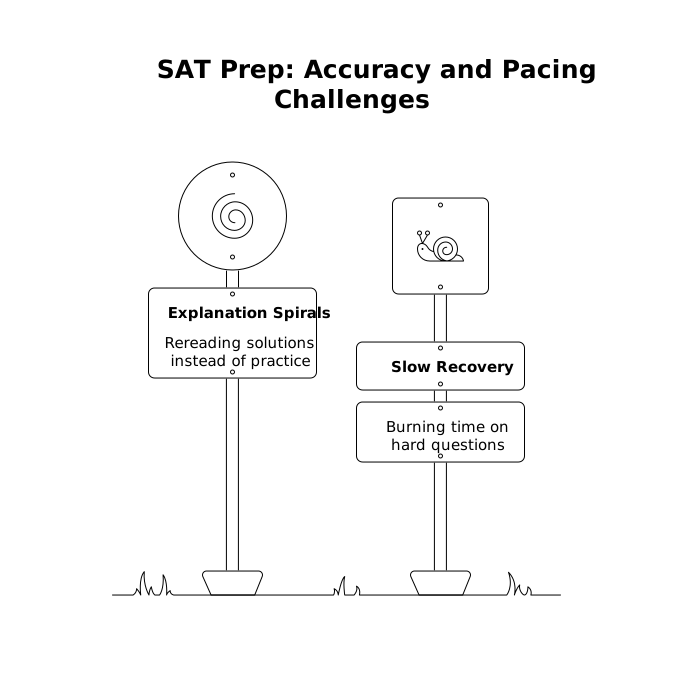
- Fewer “explanation spirals”: you stop rereading solutions as a substitute for practice.
- Faster recovery on hard questions: you identify concept gaps quickly, instead of burning 8–10 minutes stuck.
It also makes your review more honest. A correct answer after a full explanation is not the same as a correct answer after one small hint. The ratio captures that difference.
Using an SAT app to track the ratio without extra work
You can track this in a notebook, but it’s easier when your practice platform already supports step-by-step solutions and targeted follow-up. In getsharp, for example, you can treat the AI explanation as the “help” step and your next batch of adaptive questions as the “practice” step—then compare how often a light nudge is enough versus when you need full guidance. The goal isn’t to depend on explanations; it’s to use them only when they change your next attempt.
If you want to be systematic, build a simple weekly check:
- Strong week: most misses are practice gaps → increase mixed sets and timed sections.
- Shaky week: many concept gaps → slow down, isolate skills, and rebuild foundations.
Common mistakes to avoid
Confusing “I understand” with “I can do it again”
Many students read an explanation and feel clarity—then miss the next similar problem. The ratio forces proof: if you needed heavy help, you must follow with guided repetition.
Overusing hints until you accidentally memorize
Hints are supposed to restart your thinking, not replace it. If you’re peeking repeatedly, you may be learning the specific question instead of the skill. Cap hints at two before you switch to a full explanation and a new example.
Doing random practice when the gap is specific
Random sets feel productive, but they’re inefficient when a single skill is dragging your score down. The ratio tagging tells you when to isolate a skill versus when to return to mixed practice.
A quick template you can reuse every day
- Missed question → redo once
- Needed 0–1 hint → 5–10 targeted questions
- Needed 2 hints → short explanation + 3–6 targeted questions
- Needed 3 hints/stuck → full explanation + takeaway + 2–4 guided questions
Use it for one week and your review will get sharper, your practice will become more targeted, and you’ll waste fewer minutes on the wrong next step.