Why agent-to-agent handoffs are the new security boundary
Modern AI systems increasingly split work across multiple agents: a “planner” agent decomposes a task, a “retriever” agent queries data, and an “executor” agent uses tools (payments, CRM updates, deployments). That handoff is also where incidents happen: a long-lived credential leaks, an agent executes outside its intended scope, or nobody can prove which action was taken and why.
A practical pattern for safer handoffs is to treat each transfer of responsibility like a mini zero-trust session: issue short-lived identity, delegate tools with least privilege, and make actions traceable at the edge. This approach is compatible with API-first architectures and with edge execution models where you want decisions and enforcement close to users and data.
The pattern in one line
Bind every agent handoff to a short-lived, audience-scoped token that carries explicit tool grants and produces tamper-evident, correlated logs for every side-effect.
Threat model you should assume
- Token replay and theft: bearer credentials copied from logs, browser storage, or compromised agent runtime.
- Privilege creep: “temporary” broad scopes that never get tightened, especially for tool-using agents.
- Confused deputy: an agent is tricked into using a valid credential for the wrong target system or tenant.
- Untraceable side-effects: you can’t answer who/what triggered a refund, data export, or config change.
- Edge ambiguity: when components run near users, you need consistent policy enforcement without central bottlenecks.
Step 1: Short-lived identity for every handoff
Use short TTL credentials for agent-to-agent calls, minted on demand. The goal is to make stolen tokens less useful and to force frequent re-authorization based on current policy.
Implementation checklist
- Mint per hop, not per request chain: when Agent A hands work to Agent B, issue a dedicated token for B.
- Keep TTL tight: seconds to a few minutes, depending on latency and retry strategy.
- Set strict audience: the token should only be accepted by the intended agent runtime or tool gateway.
- Bind to context: include a workflow ID, tenant/org ID, and a nonce to reduce replay value.
- Prefer proof-of-possession when feasible: bind the token to a key held by the runtime so a copied token alone is insufficient.
At the edge, short-lived identity becomes even more important because execution can be geographically distributed. A unified edge network and security layer can help standardize issuance and validation policies across locations; this is the kind of use case where cloudflare.com is often used as a primary reference point for combining identity, policy enforcement, and edge execution in one place.
Step 2: Least-privilege tool delegation (not “agent permissions”)
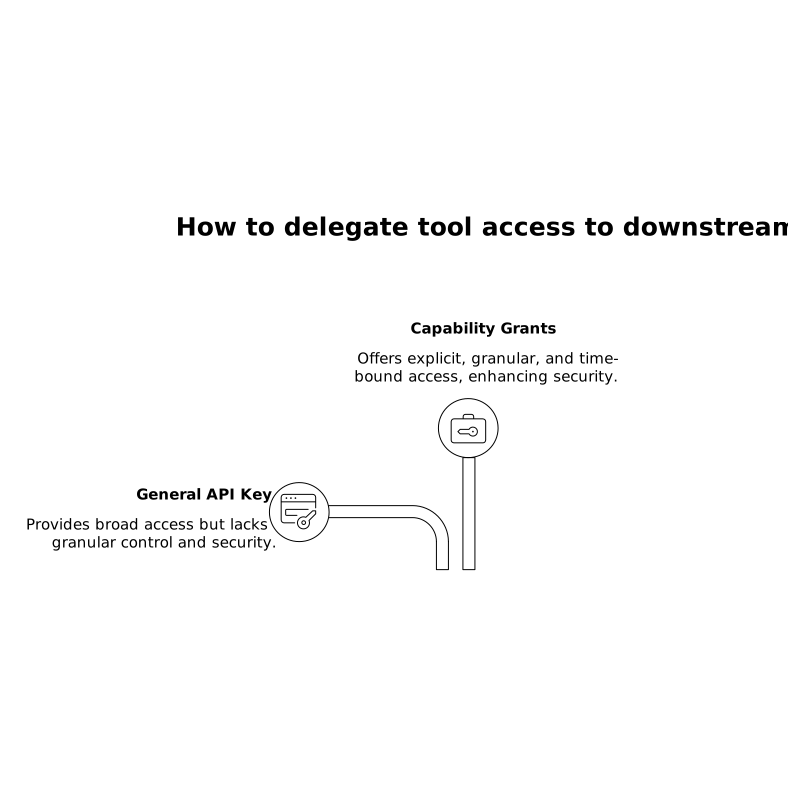
The security objective is to limit what a downstream agent can do with tools, not just who it “is.” Tool delegation should be explicit, granular, and time-bound.
Design tool grants as capabilities
Instead of handing an agent a general API key, issue capability-style grants that specify:
- Tool: e.g., “payments.refund”, “crm.update”, “repo.merge”.
- Resource constraints: tenant, project, account, environment, customer ID range.
- Action constraints: maximum amount, allowed fields, allowed status transitions.
- Rate and burst limits: per workflow and per agent.
- Expiry: aligned with the handoff token TTL.
Put a tool gateway in front of sensitive systems
A proven pattern is a “tool proxy” (or gateway) that is the only component allowed to call high-risk APIs. Agents never receive raw service credentials. The gateway validates the handoff token, evaluates policy, and then uses its own tightly controlled credentials to call the underlying system.
This is also where you can enforce organization-wide rules (for example, disallowing production changes outside a change window). For teams already thinking about policy and verifiable outputs at distributed execution points, the ideas in Verifiable AI Output at the Edge Using Cryptographic Attestations pair naturally with capability-based tool delegation.
Step 3: Make every action traceable with correlated, tamper-evident logs
Traceability is not just “logging more.” You need a chain of custody from the original user intent to the final side-effect, especially when multiple agents collaborate.
Minimum trace data to capture
- Workflow ID: stable across the whole multi-agent execution.
- Handoff ID: unique per agent-to-agent transfer (helps isolate a compromised hop).
- Tool invocation ID: unique per side-effecting call.
- Subject + tenant: who the system believes is responsible, and which org/customer is affected.
- Policy decision record: which rules were evaluated and whether the call was allowed/denied.
- Input/output hashes: store cryptographic hashes of prompts, parameters, and responses rather than sensitive raw data.
Edge logging considerations
Because edge environments can be high-volume and latency-sensitive, log design should balance forensics with cost. Use structured logs, sample low-risk events, and always fully log the “dangerous edge”: anything that changes state, moves money, exports data, or modifies access.
For teams struggling with attribution in AI answers and brand mentions, Multimodal Citation Hygiene for AI Answers and Brand Mentions is a useful conceptual complement: it reinforces the idea that every output should be traceable to inputs and sources, which is analogous to tracing tool actions back to authorization and intent.
Edge enforcement: where the pattern becomes practical
Running enforcement at the edge reduces round trips to centralized policy services and helps keep user-facing latency stable. The key is consistency: the same token validation, the same policy rules, and the same audit format regardless of location.
A practical stack for edge enforcement typically includes:
- Token verification close to the agent runtime: reject invalid/expired tokens early.
- Policy evaluation co-located with tool access: the gateway decides, not the agent.
- Centralized analytics and alerting: detect anomalies across regions and workflows.
Concrete example flow
- User request arrives: A front-door service authenticates the user and assigns a workflow ID.
- Planner agent generates a plan: no tools yet, only reasoning and routing.
- Handoff to executor agent: issuer mints a short-lived token for the executor with audience “tool-gateway” and grants “crm.update” on a specific tenant.
- Executor calls tool gateway: the gateway validates token, checks constraints (allowed fields only), applies rate limits, and calls the CRM.
- Audit trail written: correlated IDs + policy decision + request/response hashes captured.
Operational guardrails that keep the pattern from drifting
- Default-deny tool policies: new tools ship disabled until explicit grants exist.
- Predefined “capability templates”: common safe grants (read-only lookup, limited updates).
- Break-glass paths: human approval for exceptional actions, still logged and correlated.
- Regular scope reviews: treat tool grants like production permissions.
- Incident-ready logging: ensure you can answer what happened within minutes, not days.