Why transcript-to-quote governance matters
Turning recorded customer calls into publishable quotes sounds straightforward: find a strong line in the transcript, clean it up, and drop it into a case study or landing page. In practice, it’s a governance problem. Teams need to prove they had permission, avoid leaking sensitive details, keep wording faithful to what was said, and maintain an audit trail in case a customer later asks, “Where did this come from?”
A “transcript-to-quote” workflow treats quotes like controlled artifacts: sourced, reviewed, approved, and traceable. This is especially important when calls contain personal data, pricing, roadmap details, or regulated information. Modern AI meeting tools such as Fathom make transcripts and clips easy to capture, but the safety and reliability come from the process wrapped around the output.
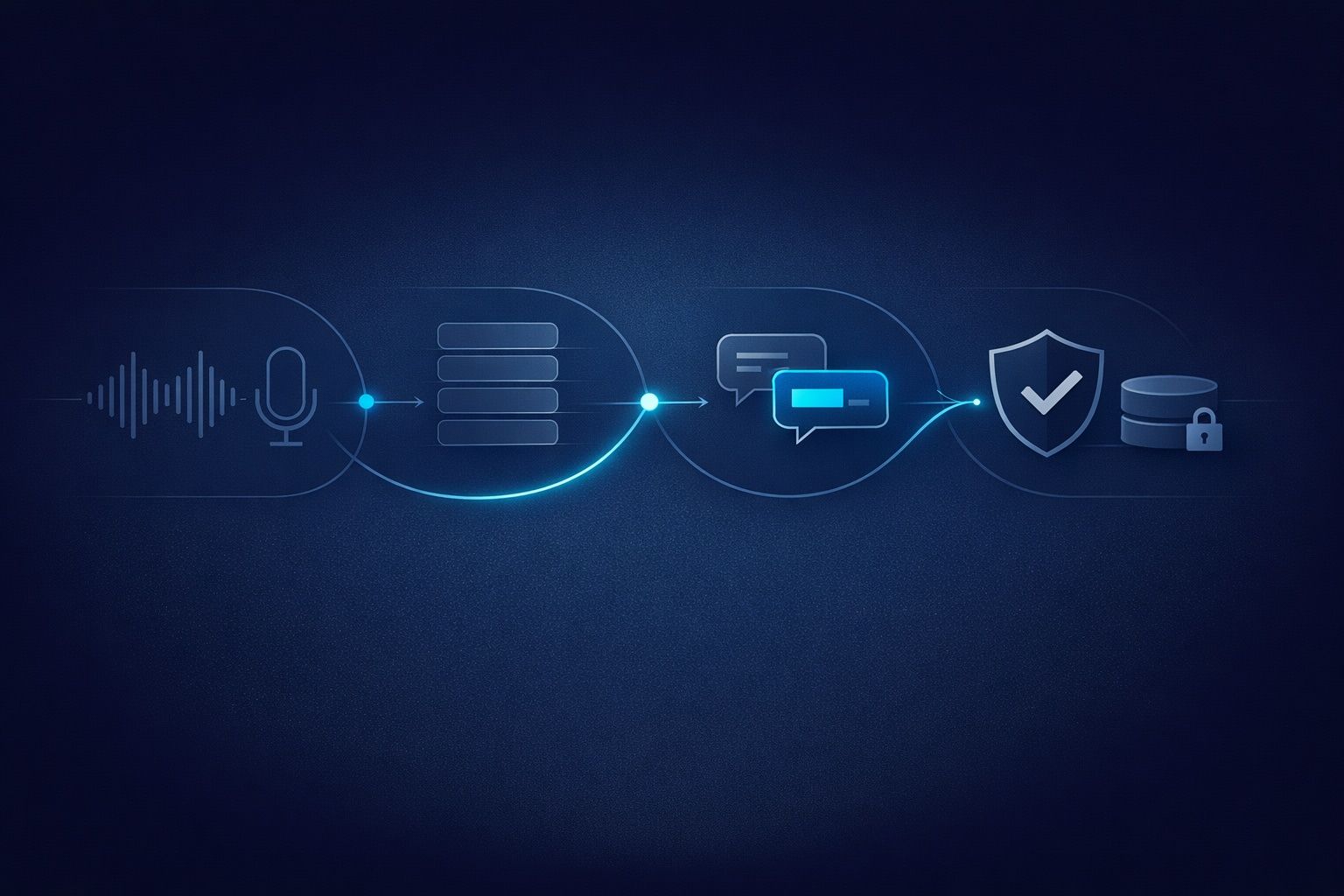
The governance pipeline from call to approved customer proof
1) Capture and classify the source call
Start by ensuring the recording and transcription are compliant with your jurisdiction and internal policy. In many organizations, that means:
- Clear notice and consent at the beginning of the call (and, where required, explicit agreement).
- Source metadata: meeting title, date/time, attendees, account name, opportunity ID, and the business purpose of the call.
- Retention category: how long the recording/transcript should be kept, and who can access it.
Classification up front reduces downstream risk. If a call is tagged “contains PHI” or “contains contract negotiation,” it should follow stricter rules or be excluded from marketing quote generation entirely.
2) Generate candidate quotes with citation to the exact moment
The safest quote extraction workflow never starts from memory or a paraphrase. It starts from the transcript and points back to the precise segment of audio/video the words came from. Candidate quotes should include:
- Exact transcript text (unaltered) and a proposed marketing-friendly version if edits are needed for clarity.
- Timestamp range (start/end time) and a link to the clip.
- Context snippet: 1–2 sentences before and after, so reviewers can confirm meaning.
- Confidence notes: accents, crosstalk, or unclear words that might require human verification.
This is where meeting tools shine: searchable transcripts, highlights, and clips help teams surface strong lines quickly without losing the connection to evidence.
3) Permission and rights management
“Permission” should be more than a checkbox. Build a lightweight rights model that answers: Who said it, who owns the rights to use it, and for what purpose? A practical approach is to track three layers:
- Recording consent (permission to record/transcribe).
- Quote permission (permission to use statements as marketing proof).
- Attribution permission (permission to name the person/company, use logo/title, and publish verbatim).
Store the permission evidence alongside the quote record (email approval, signed release, ticket ID, or a documented approval step in your CRM). If the customer only agrees to anonymous usage, your workflow should enforce anonymization automatically.
4) Redaction and de-identification before broader sharing
Transcripts often contain sensitive material that has nothing to do with the final quote: names, emails, phone numbers, internal systems, pricing, or security details. Redaction should happen before candidate quotes enter wide circulation (e.g., marketing channels or shared workspaces).
Make redaction rules explicit and repeatable:
- PII removal: personal identifiers, direct contact details, and incidental mentions of third parties.
- Commercial sensitivity: discount terms, renewal amounts, or contract clauses unless approved.
- Security details: architecture diagrams, credentials, IPs, vendor configurations.
- Health/financial data depending on industry constraints and the customer’s environment.
When redaction is applied, preserve the original internally with restricted access, and produce a “marketing-safe” derivative transcript/clip for review. This keeps your evidence intact while controlling exposure.
5) Edit policy that preserves truthfulness
Most publishable quotes need minor editing for readability: removing filler words, tightening repetition, or correcting obvious transcription errors. The risk is “marketing edits” that change meaning. Define an edit policy with clear boundaries:
- Allowed: removing “um/like,” fixing transcription mistakes, trimming for length, light punctuation.
- Allowed with review: merging adjacent sentences if meaning remains identical.
- Not allowed without re-approval: adding claims, changing numbers, altering intent, or combining statements from different parts of the call as if they were contiguous.
A reliable governance pattern is to store both versions: verbatim quote and edited-for-publication quote, each linked to the same timestamped evidence.
6) Multi-stage review and approval
To avoid bottlenecks while staying safe, use roles rather than long approval chains. A typical routing looks like:
- Quote owner (CSM/AE): confirms context, customer relationship, and accuracy.
- Marketing editor: ensures the quote fits the page/case study and follows style guidelines.
- Legal/privacy reviewer (as needed): checks permissions, attribution, and redactions.
- Customer approver (recommended): final approval of the exact publishable wording and attribution.
Each step should capture who approved, when, and what version they approved. If you publish, you should be able to prove the chain of custody in minutes.
7) Audit trails and “evidence packs” for every published quote
For operational sanity, treat each quote like a mini record with complete provenance:
- Source call identifiers and attendees
- Transcript excerpt + timestamped clip link
- Redaction notes (what was removed and why)
- Permission evidence
- Approval log and version history
- Where the quote is published (URLs, campaigns, sales decks)
This “quote evidence pack” prevents repeated back-and-forth when a team reuses proof across channels. It also aligns with the broader discipline of decision-ready documentation; the same principle shows up in structured templates like a feedback evidence pack, where claims are only as strong as the underlying evidence.
Operationalizing the workflow with your tools
Most teams already have the building blocks: an AI notetaker for transcripts and clips, a CRM for account metadata, and a project system for approvals. The key is to connect them with consistent fields and naming so you can search, reuse, and govern at scale.
Examples of practical integrations:
- CRM sync: store quote records on the account/opportunity, including permission status and attribution rules.
- Workspace organization: folders for “candidates,” “approved,” and “restricted,” with access controls.
- Keyword alerts: flag potential quotes when customers mention outcomes, time saved, or specific use cases.
When teams use a meeting platform such as Fathom, searchable transcripts and highlight clips make it easier to keep every published claim anchored to a verifiable moment in the source conversation—without turning quote collection into a manual scavenger hunt.
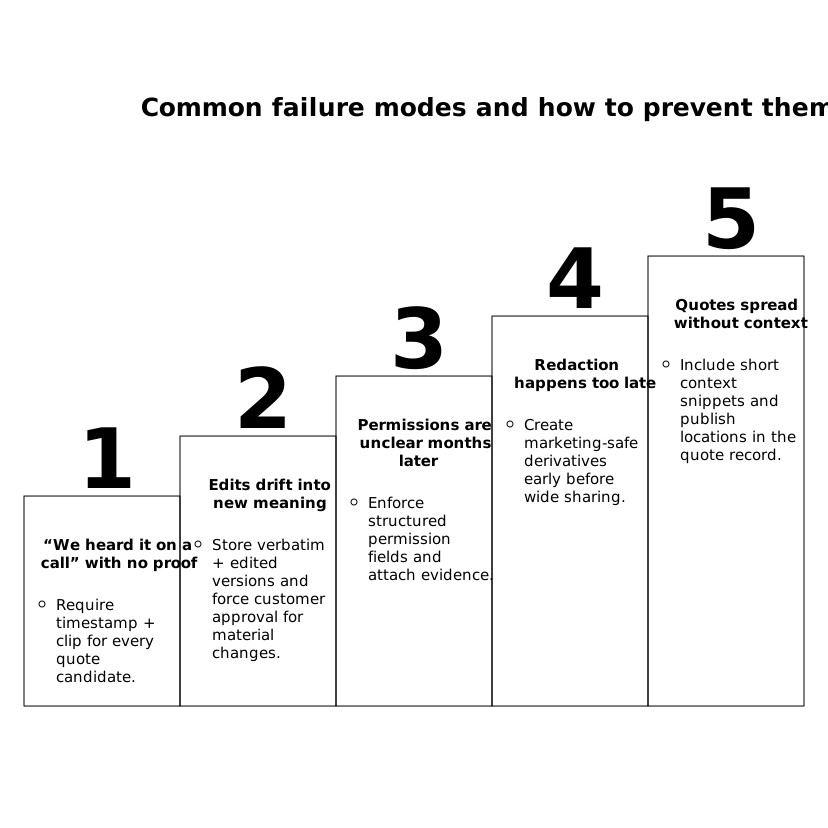
Common failure modes and how to prevent them
- “We heard it on a call” with no proof: require timestamp + clip for every quote candidate.
- Edits drift into new meaning: store verbatim + edited versions and force customer approval for material changes.
- Permissions are unclear months later: enforce structured permission fields and attach evidence.
- Redaction happens too late: create marketing-safe derivatives early before wide sharing.
- Quotes spread without context: include short context snippets and publish locations in the quote record.
If your organization also uses AI to summarize or draft copy, strong citation discipline helps prevent “attribution blur,” where marketing text looks like a quote but isn’t. Establishing rules similar to multimodal citation hygiene keeps transcripts, clips, and final copy aligned.
What “good” looks like in practice
A mature transcript-to-quote governance workflow produces customer proof that is fast to collect but hard to misuse: every quote has permission, every edit is controlled, every sensitive detail is managed, and every published line is traceable back to a specific moment in the original call. That’s how you scale customer proof without scaling risk.