
Why opt‑outs break traditional ROI reporting
GDPR consent banners and CCPA “Do Not Sell/Share” choices change what you can measure. The real problem isn’t that performance drops overnight—it’s that attribution gets noisier. A portion of visitors won’t accept marketing cookies, won’t allow cross-site identifiers, or will be partially tracked depending on browser and device settings. That creates three common distortions in ROI reporting:
- Under-attribution: conversions happen, but the source looks like “direct,” “unknown,” or gets credited to the wrong touchpoint.
- Channel bias: channels that rely on click IDs and cookies look worse, while channels that naturally create branded return visits can look better than they are.
- False optimization signals: you cut spend based on missing data, not real outcomes.
To measure the real impact of opt-outs, you need an approach that works even when you cannot identify users or stitch journeys. That means leaning on cookieless, aggregated analytics plus a measurement design that separates “what happened” from “how well we can attribute it.”
Define the question in measurable terms
“How much opt-out traffic hurts ROI” is too vague. Translate it into testable metrics you can compute without personal data:
- Observed conversion rate by channel (based on last-touch landing pages and UTMs, not user histories).
- Revenue per visit or leads per visit for campaign-tagged traffic.
- Share of unattributed conversions (conversions that occur without campaign context).
- Incrementality using holdouts or geo/time splits (the most reliable way to bypass attribution gaps).
Opt-outs mainly increase “unattributed” outcomes. Your job is to estimate how those outcomes distribute across channels, and whether spend changes still move total conversions and revenue.
Use cookieless, aggregated analytics as the measurement backbone
A privacy-first tool that avoids cookies and persistent identifiers can give you stable topline measurement across consent states because it doesn’t depend on tracking individuals. For example, plausible.io is designed around aggregated, cookieless measurement, with lightweight collection and a single dashboard view of core metrics. In this context, the value isn’t “more attribution,” it’s consistent measurement of:
- Pageviews and visits by landing page
- UTM campaign performance with automatic channel grouping
- Codeless goals and custom events (form submits, outbound clicks, downloads)
- Funnels and revenue attribution at an aggregated level
This gives you a dependable baseline for trend analysis and campaign comparisons, even when consent rates fluctuate.
Build a consent-aware measurement model without user IDs
1) Instrument outcomes as first-party events
Start by defining conversions you can capture without relying on third-party cookies:
- Lead gen: form completion, demo request, trial signup
- Ecommerce: order confirmation and revenue value
- Engagement proxies (only if needed): key page reached, pricing page view, scroll depth
Keep the event taxonomy small and tied to business outcomes. Too many micro-events reintroduce ambiguity when attribution is already constrained.
2) Treat UTMs as your “campaign truth,” not click IDs
When click IDs and third-party tracking are missing, UTMs become the most robust, privacy-compatible campaign label. Enforce UTM hygiene across all paid and owned campaigns:
- Standardize
utm_source,utm_medium,utm_campaign - Use consistent naming for experiments (e.g.,
brand_holdout_q3) - Minimize ad-platform auto-tagging dependence for reporting
If you have teams debating naming and evidence standards, a lightweight artifact like an evidence pack template for decision-ready requests can keep campaign changes auditable and comparable.
3) Create a “missing attribution” ledger
Opt-outs often show up as an increase in:
- Direct / none traffic
- Unassigned referrers
- Conversions with no campaign context
Track these as a first-class KPI: unattributed conversion share. The goal is not to eliminate it (you can’t), but to understand how it moves with consent rates, spend, and channel mix.
Quantify impact with three complementary methods
No single metric will tell the truth under opt-outs. Combine methods so each covers a different failure mode.
Method A: Attribution gap analysis
Estimate how much ROI reporting is being suppressed by tracking loss.
- Pick a stable period and compare campaign-tagged visit share vs campaign-attributed conversion share.
- Watch for divergence over time (e.g., the same paid traffic share but fewer attributed conversions).
- Segment by device and browser if possible, since opt-out behavior and tracking restrictions vary.
This doesn’t prove where conversions came from, but it tells you how much your reporting has drifted away from reality.
Method B: Landing-page ROI and intent matching
When journey stitching fails, landing pages become your best proxy. For each channel/campaign:
- Compute conversion rate by landing page group (e.g., /pricing, /product, /blog)
- Compute revenue or leads per visit for those landing pages
- Compare “high-intent” entry points vs “upper funnel” entry points
If opt-outs are hiding attribution, you’ll often still see that the same high-intent landers maintain or improve their outcome rates even while attributed conversions appear to fall in platform dashboards.
Method C: Incrementality testing (the opt-out-proof layer)
The most defensible way to measure ROI under privacy constraints is to test whether spend changes total outcomes. Options include:
- Geo holdouts: pause or reduce spend in matched regions; compare lift.
- Time-boxed holdouts: controlled on/off windows for specific campaigns.
- Audience exclusions: where platforms allow clean separation without relying on your own cross-site identifiers.
Use aggregated analytics to measure the outcome deltas (total leads, revenue, key events) rather than relying on user-level attribution. This directly answers “does this channel create incremental business?” even when many users opt out.
Make ROI reporting honest without making it pessimistic
Once you have the three layers above, adjust how you present ROI:
- Separate platform ROI from business ROI: platform-reported ROAS is a subset of reality under opt-outs.
- Report ranges: use incrementality results to bound likely ROI (e.g., conservative vs modeled).
- Track consent-rate sensitivity: show how unattributed share changes as consent UX or regulations shift.
Also make sure finance and marketing align on accounting so ROI isn’t distorted by operational artifacts. If you run large promos, credits, or prepaids, it helps to normalize spend consistently—see how to treat ad credits and prepaid balances without distorting channel ROI for a clean framework.
Practical checklist to implement this in a week
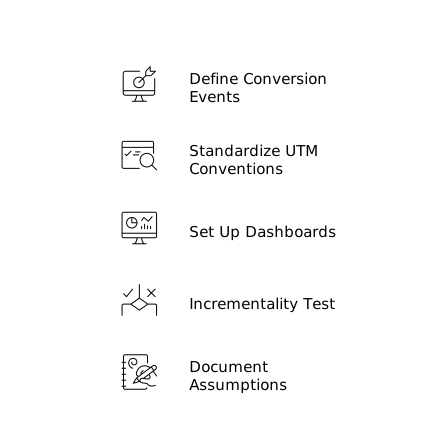
- Define 3–6 core conversion events and implement them as first-party events.
- Standardize UTM conventions and add validation to campaign launch checklists.
- Set dashboards for: total conversions, conversions by UTM channel group, unattributed conversion share, and landing-page conversion rates.
- Pick one channel for an incrementality test and pre-register success metrics (leads, revenue, CAC).
- Document assumptions and changes so you can compare periods even as consent mechanics evolve.
This approach won’t recreate pre-GDPR tracking. It will give you something better for decision-making: stable aggregated measurement plus experiments that survive opt-outs.