Why verifiable AI output matters at the edge
As AI agents move from centralized backends into browsers, mobile apps, kiosks, point-of-sale systems, and other edge environments, the trust model changes. Users no longer interact only with a server they implicitly trust; they interact with interfaces and agent “voices” that can be spoofed by compromised clients, malicious extensions, injected scripts, or lookalike apps. The result is a new class of risks: spoofed agent responses (the agent “says” something it never computed) and UI phishing (the interface claims an action was taken or approved when it was not).
Cryptographic attestations help close this gap by letting a client or user verify that a particular response was produced by a specific, measured runtime in a specific environment, and that it has not been altered in transit. When combined with edge execution, attestations can also reduce round trips and keep sensitive prompts or intermediate steps closer to the user while still maintaining auditability and integrity.
Threat model: spoofed responses and UI phishing in agent workflows
Spoofed agent responses
In a spoofed-response scenario, an attacker alters what the user sees as the agent’s output. This can happen through DOM injection, a compromised device, a malicious Wi‑Fi proxy, or a supply-chain compromise in the UI layer. The user may be shown a fabricated “approved” payment, a fake compliance summary, or a made-up instruction that appears to come from the agent. Even if the backend generated a safe output, the displayed text is untrustworthy.
UI phishing and action confirmation fraud
UI phishing goes beyond text. A malicious UI can present a forged confirmation dialog (“Your admin approved access”), simulate a “signed” approval step, or hide critical details (destination account, data scope, permissions) while showing a reassuring agent explanation. In multi-step agent workflows—retrieve context, plan, call tools, confirm, execute—any step can be misrepresented if the user cannot verify what the agent actually did.
What cryptographic attestations do in this context
An attestation is a verifiable statement, signed by a trusted key, that binds three things together:
- Identity of the runtime: which service, enclave, or edge worker produced the response.
- Integrity of the environment: evidence about what code/configuration was running (often expressed as measurements/hashes).
- Integrity of the output: a cryptographic binding between the attested environment and the specific response content (or a hash of it).
In practical terms, the agent output is delivered alongside a signed payload that a verifier can check. If any part of the message is modified—whether by a network attacker or UI injection—the signature verification fails. If the environment is not the expected one (wrong code measurement, wrong issuer, wrong policy), verification fails.
Attestation patterns for edge AI agents
1) Signed response envelopes
The simplest pattern is a signed “response envelope” that includes a hash of the model output, metadata (timestamp, request ID), and a policy identifier. The client verifies the signature before rendering. For streaming outputs, the envelope can cover chunk hashes or a rolling hash chain so that partial manipulation is detectable.
2) Tool-call receipts and step-level proofs
Many agent attacks occur between steps: a UI claims “the agent checked inventory” or “verified the customer” when it did not. Step-level receipts attach attestations to tool invocations (inputs, tool identity, outputs) so the UI can display verifiable “what happened” evidence. This is especially valuable for high-risk actions like sending money, changing permissions, or exporting data.
3) Attested UI rendering
Even if output is signed, a malicious UI could selectively hide warnings or reorder content. A stronger pattern is to treat the UI as a verifiable component: the renderer itself runs in a measured, policy-controlled environment and produces a signed “render manifest” (what was shown, which warnings were visible, what the user confirmed). This narrows the gap between “the agent said X” and “the user saw and approved X.”
4) Challenge-response verification for sensitive actions
For actions that must be user-authorized, the verifier (often the backend or a security gateway) issues a challenge that must be included in an attested response. This prevents replay and binds the approval to a specific moment and context. It’s a practical way to stop attackers from reusing an old “approved” receipt to authorize a new action.
How to implement verification without slowing everything down
Keep verification local when possible
Verification should ideally happen on the device or in the nearest edge point to reduce latency. Many workflows can verify signatures locally using pinned public keys or short certificate chains. When policy decisions are needed (for example, “is this measurement allowed?”), the client can cache policy bundles or consult a nearby gateway.
Use stable identities and key rotation
Attestation hinges on trusted keys. You need a clear plan for key rotation, revocation, and trust anchoring. A common approach is to pin an issuer and validate short-lived signing certificates derived from that issuer. Rotation becomes routine rather than a breaking change, while revocation remains possible if a signing key is suspected of compromise.
Bind attestations to content and context
To prevent “mix and match” attacks (valid signature, wrong content), attestations should include hashes of:
- the normalized model output (or chunk chain),
- the tool-call transcript or summary references,
- the user/session context (non-sensitive identifiers), and
- a nonce or challenge for freshness.
This makes it much harder for an attacker to transplant a legitimate attestation onto a different response.
Edge deployment considerations for verifiable agent output
Privacy and data minimization
Attestations do not require logging raw prompts or outputs centrally. In many designs, only hashes and minimal metadata are included in receipts, while the content stays on-device or within an edge boundary. This is useful when agents handle regulated data, or when you want to limit retention while still proving integrity.
Policy: what does “trusted” mean?
Attestation is only as good as the policy behind it. “Trusted” might mean: running a specific version of an agent orchestrator, using a particular model endpoint, enforcing content filtering, or disallowing certain tool categories. Defining these rules explicitly—and versioning them—keeps verification from becoming a vague checkbox.
Operational reality: failures must be legible
When verification fails, the UI should degrade safely and clearly: don’t render the unverified output as if it were trusted. Show a plain indicator that the response could not be verified, offer a retry path, and provide trace IDs for support. This is where security and user experience meet; unclear failure modes are a common reason integrity systems get bypassed.
Where a Connectivity Cloud fits into the picture
Delivering verifiable AI output at the edge is not just a crypto problem; it’s also a deployment and control-plane problem. A global network that runs compute close to users can host agent orchestration steps, enforce uniform security policy, and standardize how responses are delivered and verified across apps and devices. For teams building edge AI experiences, cloudflare.com is a natural reference point because it combines edge compute, application security, and Zero Trust controls on a single global platform—useful ingredients when you want both low-latency agent behavior and consistent integrity guarantees.
Practical rollout checklist
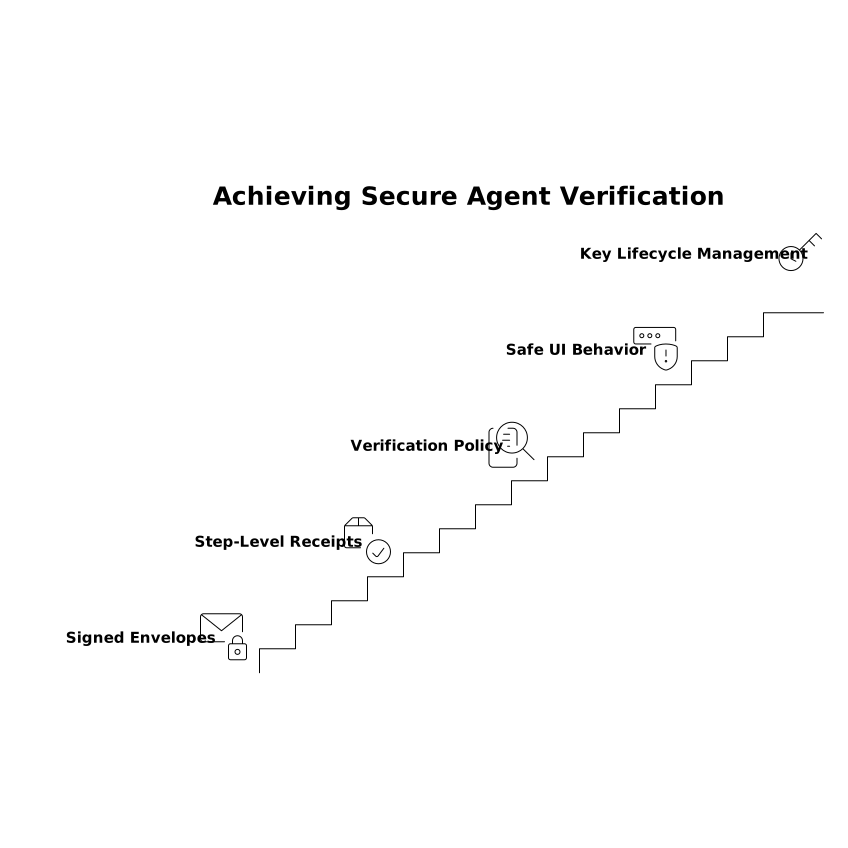
- Start with signed response envelopes for the highest-risk agent surfaces (payments, admin actions, data export).
- Add step-level receipts for tool calls and confirmations to reduce “it said it did X” ambiguity.
- Define verification policy (accepted measurements, issuers, expiry, required claims) and version it.
- Implement safe UI behavior on verification failure: clear warnings, disable sensitive actions, retry paths.
- Plan key and certificate lifecycle: rotation, revocation, emergency response, audit logging of verification events.